

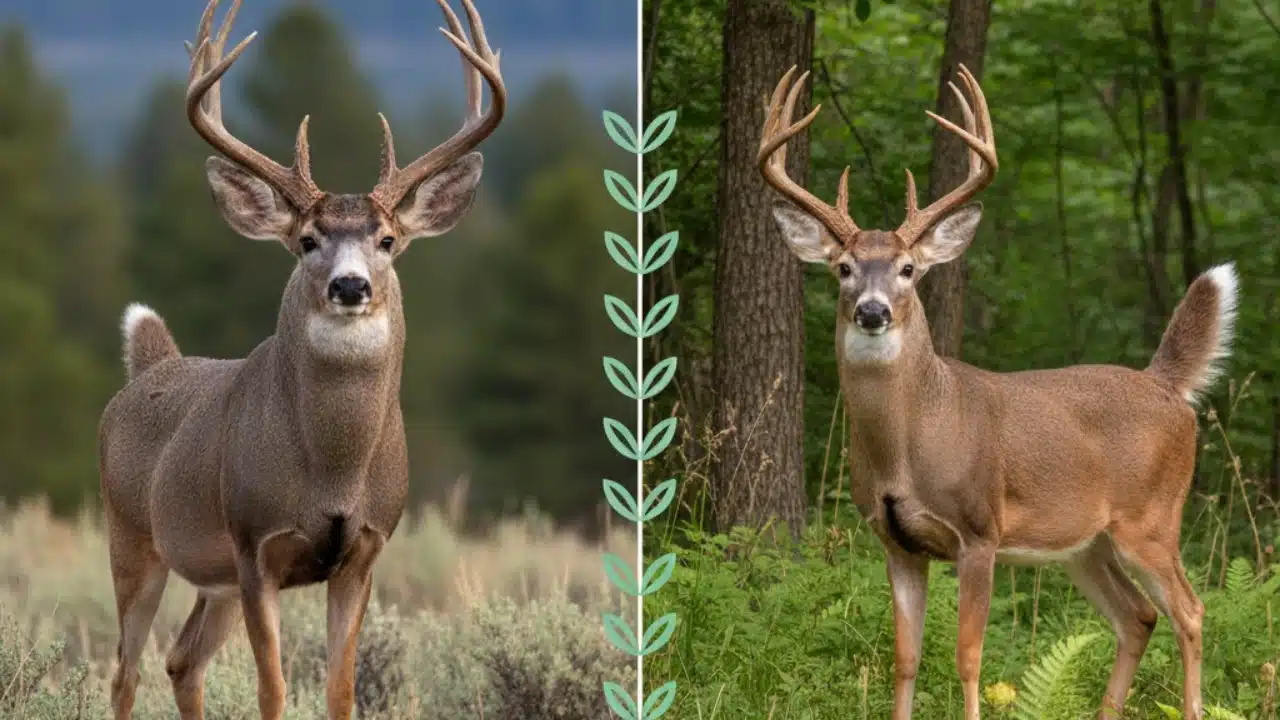
If you’ve headed into the wilderness and paused at that moment — “Is that a mule deer or a whitetail?” — you’re in good company. These two deer species dominate the North American hunting scene, but telling them apart and planning a successful hunt requires more than a glance. This guide from Hunt Nation lets you confidently identify mule deer vs whitetail, understand when and where to hunt them, and plan your trip down to price and timing.
Contact Hunt Nation: 📞 +1 307-637-5495 | ✉️ info@hunt-nation.com
What Makes Mule Deer and Whitetails Different?
While mule deer (Odocoileus hemionus) and whitetail deer (Odocoileus virginianus) share many similarities, their adaptations, behaviors, and habitats diverge in ways that matter for hunters. Mule deer are built for wide-open, rugged terrain; whitetails thrive in forest edges, mixed cover and more populated zones. Recognizing these differences gives you the edge.
Mule Deer vs Whitetail
| Feature | Mule Deer | Whitetail Deer |
|---|---|---|
| Ears | Very large, rounded | Smaller, pointed and upright |
| Antlers | Forked Y-shaped splits | Main beam with vertical tines |
| Tail/Rump | White rump patch; tail short with black tip | Brown back; underside white “flag” when alarmed |
| Escape Style | Western mountains, plains, and arid zones | Gallops/sprints, tail raised high |
| Average Size | Larger, heavier bucks | Slightly smaller on average |
| Habitat | Milder, slightly sweet if the diet rich | Forest edges, farmland, east & central regions |
| Taste Profile | Earthy, sage-forward when diet reflects terrain | Milder, slightly sweet if the diet is rich |
| Best Season to Hunt | Late November into early December in many western zones | Bounds (all four off the ground) |
How to Tell Them Apart in the Field
Ears
If you see a deer with oversized, rounded ears, odds are you’re looking at a mule deer. Those huge ears help detect predators across open terrain. Whitetails have shorter, more upright ears that fit their forested or mixed-cover habitats.
Antlers
On a buck, antler structure says a lot. Mule deer typically carry forks—branching out, then forking again. Whitetails stick with one main beam and tines growing off of it. Scan the ridgeline: “Y” shapes = mule deer.
Tail and Rump
One of the surest tells: a white rump patch with a short black-tipped tail = mule deer. If you see a deer flash a white underside tail like a flag as it flees, you’re likely watching a whitetail.
Movement / Behavior
Mule deer have a signature bounding motion (called “stotting”) — all four feet leave the ground. Whitetails tend to sprint and bound in long strides through cover, often raising their tail high as they bolt.
Seasonality & Best Time to Hunt
Mule Deer
In many western states, the best time to hunt mule deer falls around late November into early December, when the rut peaks and bucks are most visible. Hunting earlier (October) can still yield results but the bucks may be less active or in heavier cover.
Whitetail
Whitetail season varies significantly by state, but generally the mid-November through early December timeframe offers peak activity as bucks chase does and food sources consolidate. However, many states open archery seasons earlier (September/October) and continue through December or beyond. Always check the individual state regulations.
Planning Your Trip with Hunt Nation
Because your catalogue at Hunt Nation shows a wide variety of hunts (multi-species, multiple states, etc.), you can use the page to compare pricing, seasons, and locations. When sorting hunts by species (e.g., “Mule Deer” or “Whitetail Deer”), you’ll notice variation in cost depending on region, outfitter, and season. Use that to match your budget and timing.
Pricing Guide & What to Expect
Your website’s catalog provides a strong reference for budget planning. The actual hunt cost will depend on state, tag cost, outfitter services, duration, and amenities. Here are general guidelines:
- Entry-level hunts (1-2 days, moderate terrain, western plains) may cost less.
- Premium hunts (mountain mule deer, trophy whitetails, remote lodging) will run higher.
- Deposit and payment details: your catalogue page notes a 3.5% surcharge on credit-card transactions.
- Always confirm what’s included (meals, lodging, tag, and guide), and ask about additional costs (transport, meat processing, gratuities).
When you contact Hunt Nation, let them know your budget, desired species (mule deer or whitetail), region, and preferred season. They can filter catalogue listings accordingly and get you a clear cost.
Taste & Field Care
The taste difference between mule deer and whitetails often comes down to diet and terrain, not species alone. Mule deer in sagebrush country may pick up stronger, herbaceous flavors. Whitetails feeding on acorns, corn or alfalfa may taste milder and sweeter.
Proper field care is critical: prompt field dressing, cooling, and aging make more difference than species. A well-handled mule deer in good condition will taste better than a poorly handled whitetail.
Conservation, Range & Trends
Both species are important to North American wildlife management. Mule deer in the West face habitat shrinking and corridor issues; many states (via agencies like WAFWA) now emphasize migration mapping and large-landscape planning. Whitetails have thrived in many regions, often expanding into suburban zones, but face challenges such as overbrowsing, disease, and vehicle collisions.
As a hunter, choosing hunts that support ethical management and conservation helps ensure sustainable populations. Hunt Nation partners and outfitters often work with state wildlife agencies, so ask about tagging, quotas, and conservation practices when you book.
Ready to plan your next guided mule deer or whitetail hunt with Hunt Nation?
Call +1 307-637-5495 or email info@hunt-nation.com now. Use our catalogue page to compare hunts by pricing, region and season—and let our experienced booking team walk you through the best options based on species, budget and timing.
Frequently Asked Questions (FAQs)
Are mule deer always larger than whitetails?
Not always. While mule deer often trend larger, regional variations and nutrition cause significant overlap. Always identify by physical traits rather than size alone.
What is the easiest way to tell them apart?
Look at the tail and rump first: white rump + black tip = mule deer. White flag tail = whitetail. Combine with ears and antlers for confidence.
When is the best time to hunt each species?
Generally, mule deer are found in late November to early December in many Western states; whitetail mid-November through early December (depending on region). Check state regulations and outfitter timing.
How much should I budget for a hunt?
Costs vary widely. Use the Hunt Nation catalogue to find current listings. Expect lowest to highest tier based on duration, terrain and amenities. Confirm what’s included and any extra fees.
Conclusion
Identifying and planning a hunt for mule deer vs whitetail becomes far simpler when you combine clear field ID cues (ears, antlers, tail, behavior) with smart planning around season, budget and region. With the insight above and the catalogue resources from Hunt Nation, you’re empowered to choose wisely and prepare thoroughly.
Hunt responsibly, stay informed, and enjoy the journey into some of North America’s most iconic habitats. Hunt Nation is here to guide you every step of the way.