

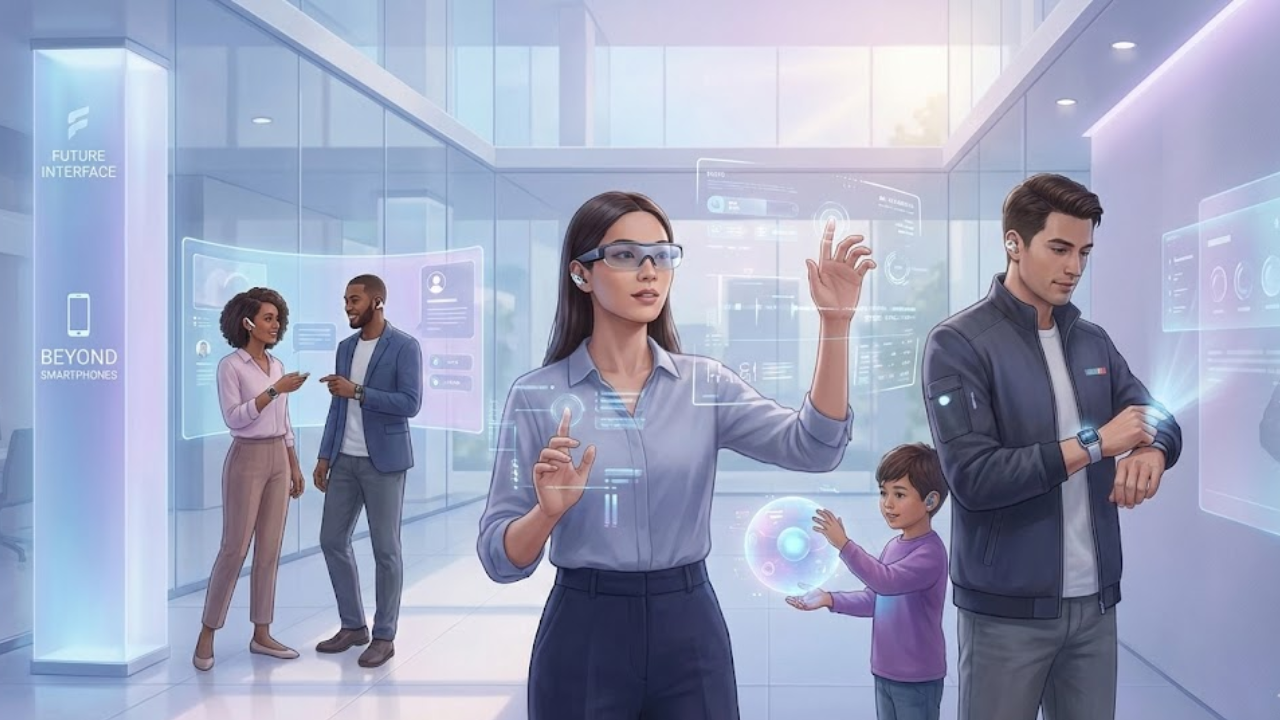
For nearly two decades, smartphones have defined how people communicate, work, and consume information. However, as technology matures and user behavior evolves, tech giants envision a future beyond smartphones, where screens are no longer the primary gateway to digital experiences. Instead, computing is becoming more immersive, intuitive, and seamlessly integrated into daily life.
Leading companies such as Apple, Google, Meta, Microsoft, OpenAI, and Neuralink are investing heavily in augmented reality (AR), artificial intelligence (AI), ambient computing, wearables, and even brain-computer interfaces. Their shared vision points toward a post-smartphone era shaped by hands-free interaction, contextual intelligence, and invisible technology.
Why Tech Giants Are Looking Beyond Smartphones

The smartphone market is approaching saturation. While global shipments have stabilized, innovation has slowed, and consumers are upgrading devices less frequently. At the same time, expectations for technology are rising; users want faster access to information, reduced screen time, and more natural interactions.
Several forces are driving this shift:
- Market maturity: Smartphones have become incremental products rather than transformative ones.
- Advances in AI: Modern AI systems can interpret voice, visuals, gestures, and context in real time.
- Demand for hands-free experiences: Consumers increasingly prefer technology that works passively in the background.
- Privacy awareness: On-device processing and personalized interfaces reduce data exposure.
- Economic opportunity: Analysts estimate that post-smartphone technologies could unlock a multi-trillion-dollar market by 2030.
These factors explain why tech giants envision a future beyond smartphones not as an experiment, but as a strategic necessity.
The Timeline Toward a Post-Smartphone Era
The transition away from smartphones will not happen overnight. Instead, it is unfolding in clearly defined stages:
- 2025–2026: Early consumer adoption of AI wearables and lightweight AR glasses
- 2027–2028: Wider enterprise and consumer use, with ambient AI embedded into homes and workplaces
- 2029–2030: Hundreds of millions of users relying on post-smartphone technologies as their primary digital interface
Rather than disappearing entirely, smartphones are expected to become supporting devices within a broader ecosystem.
How Major Tech Giants Are Shaping the Future

Meta: Bringing AR Glasses to the Mainstream
Meta has invested tens of billions of dollars into augmented and virtual reality. After the success of Ray-Ban Meta smart glasses, the company is moving toward fully functional AR wearables capable of real-time AI assistance, visual overlays, and contextual awareness.
Meta’s long-term goal is to make AR glasses as common as smartphones once were, though battery life and affordability remain key challenges.
Neuralink: Redefining Interaction Through Brain-Computer Interfaces
Neuralink represents the most radical shift away from screens. Its brain-computer interface technology enables direct communication between the human brain and digital systems. Early clinical trials have already demonstrated thought-controlled computing for patients with paralysis.
While widespread adoption remains years away, rapid investment growth shows strong confidence in BCIs as a long-term alternative to traditional devices.
OpenAI: Ambient Intelligence Everywhere
OpenAI’s vision centers on ambient AI, intelligence that exists within environments rather than devices. Instead of opening apps or tapping screens, users receive assistance through voice, automation, and contextual awareness.
This approach reduces friction and aligns closely with how tech giants envision the future beyond smartphones, where interaction feels natural rather than mechanical.
Google: Building an Open AR and AI Ecosystem
Google is developing an open extended-reality platform in partnership with hardware leaders. Its strategy mirrors Android’s role in smartphones, offering a flexible ecosystem for AR glasses, AI assistants, and smart environments.
By combining AI, edge computing, and cloud infrastructure, Google aims to accelerate adoption across both consumer and enterprise markets.
Apple: Expanding Into Spatial Computing
Apple is evolving beyond smartphones by focusing on spatial computing. Devices like Vision Pro represent an early step toward blending digital content with physical space. Rumored lightweight AR glasses are expected later in the decade.
Rather than abandoning smartphones abruptly, Apple is positioning them as part of a tightly integrated ecosystem that gradually shifts toward screenless interaction.
Microsoft: Enterprise-Focused Mixed Reality
Microsoft’s approach prioritizes enterprise use cases. Through mixed reality devices and cloud-based AI, the company enables training, design, and collaboration in industrial environments.
While less consumer-oriented, Microsoft’s work supports the broader ecosystem, enabling a future beyond smartphones.
Core Technologies Enabling the Transition
Several breakthroughs are making post-smartphone computing practical:
Display Innovations
- Lightweight waveguide AR optics
- Retinal projection and experimental contact-lens displays
- Early holographic interfaces for device-free interaction
AI Processing Models
- On-device AI for privacy and speed
- Specialized chips optimized for AI workloads
- Hybrid cloud-edge systems balancing performance and efficiency
Energy and Power Advancements
- Solid-state batteries with higher density
- Wireless charging for wearables
- Energy harvesting from motion and ambient sources
Together, these technologies make it possible to reduce reliance on traditional screens.
Challenges Slowing Adoption
Despite momentum, several obstacles remain:
- Privacy and ethical concerns around constant data collection
- Battery limitations in compact wearables
- Social acceptance of AR glasses and implants
- Cybersecurity risks in always-connected environments
Addressing these issues will determine how quickly consumers embrace life beyond smartphones.
What This Shift Means for Society and the Economy
If successful, the post-smartphone transition could:
- Reduce screen dependency and digital fatigue
- Improve accessibility for people with disabilities
- Boost productivity through automation
- Generate trillions in global economic value
AI alone is expected to add trillions to global GDP, and post-smartphone platforms will amplify that impact across industries.
Final Thoughts
The smartphone era is not ending; it is evolving. As tech giants envision a future beyond smartphones, they are building technologies that prioritize seamless interaction, contextual intelligence, and human-centric design.
AR glasses, ambient AI, wearables, and brain-computer interfaces are no longer speculative ideas. They are active investments shaping the next generation of computing. While challenges remain, the direction is clear: the future of technology extends far beyond the smartphone screen.
Frequently Asked Questions
1. Why do tech giants envision a future beyond smartphones?
Tech giants envision a future beyond smartphones because mobile innovation has slowed, while AI, AR, and wearables enable hands-free, more natural interactions with technology.
2. Will smartphones disappear in the future?
No, smartphones are unlikely to disappear immediately. Instead, they will gradually become secondary devices as wearables and ambient computing take a primary role.
3. What technologies will replace or reduce smartphone use?
Technologies such as AR glasses, ambient AI, wearables, and brain-computer interfaces are expected to reduce reliance on smartphones over the next decade.
4. Which companies are leading the post-smartphone future?
Apple, Google, Meta, Microsoft, OpenAI, and Neuralink are leading investments in AR, AI, spatial computing, and brain-computer interfaces.
5. When will post-smartphone technologies become mainstream?
Early adoption is expected between 2025–2026, with broader mainstream use projected between 2027–2030 as devices become more affordable and practical.
6. What are the biggest challenges to a future beyond smartphones?
Key challenges include privacy concerns, battery life limitations, social acceptance of wearables, ethical issues, and cybersecurity risks.

