

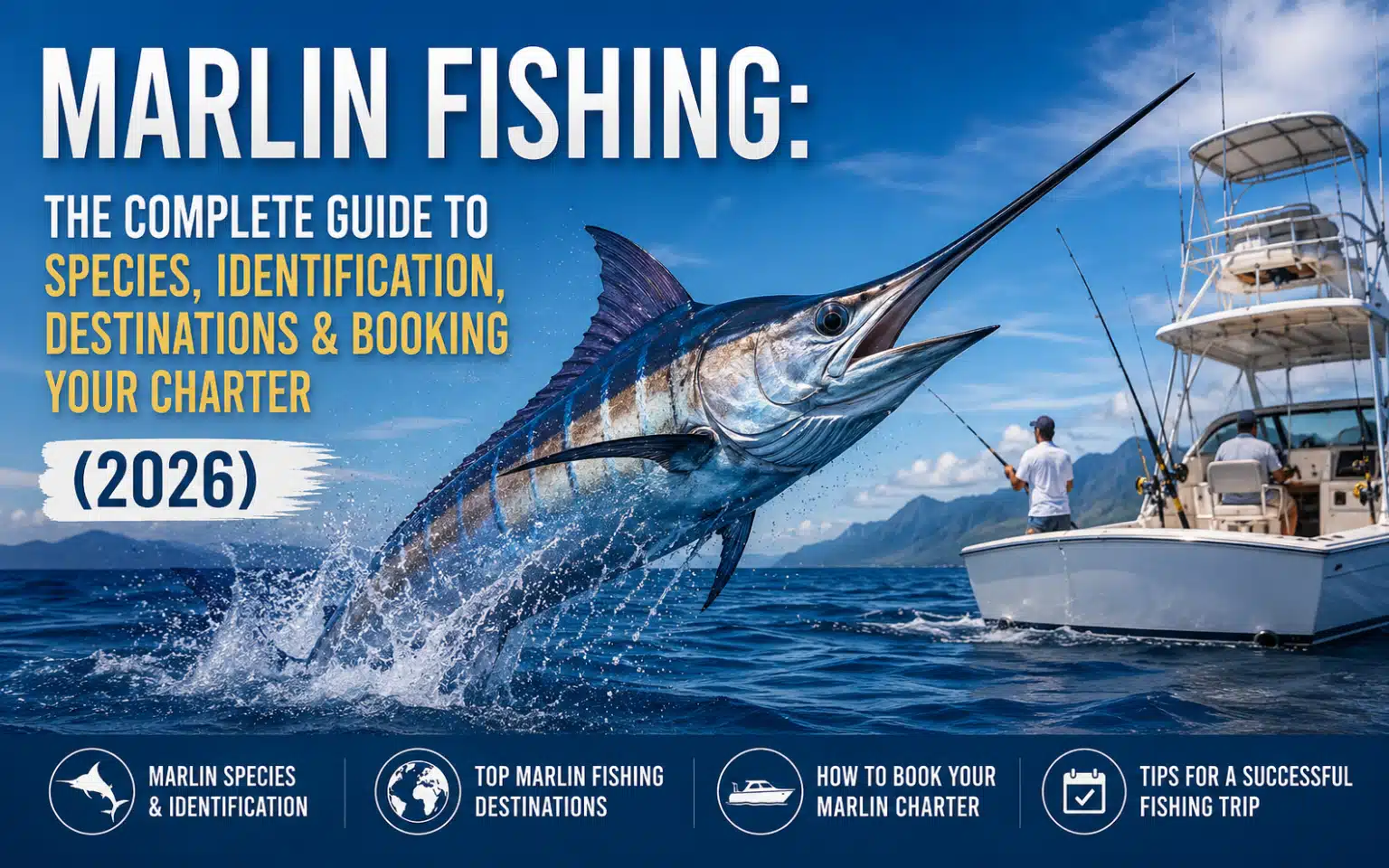
There is no fish quite like a marlin. The moment one crashes your spread, a thousand pound predator rocketing out of the deep blue, bill slashing, colors flashing electric purple and silver, everything changes. That first run strips line off your reel faster than almost anything else in sport fishing.
Marlin fishing is big game offshore fishing at its purest. These billfish roam warm tropical and subtropical waters worldwide, and landing one is on nearly every serious angler’s bucket list. For over 27 years, Fish-Nation has connected anglers with the world’s best marlin fisheries, from Panama’s offshore canyons to the blue water grounds of Costa Rica and Guatemala.
This guide covers what most marlin content skips: how to actually tell the four species apart, the records that define the sport, and the destinations, techniques, and costs that turn a bucket list dream into a booked trip.
Marlin Species: Identification, Records, and Behavior
Not all marlin are the same fish, and telling them apart matters, both for bragging rights at the dock and for choosing the right destination and season.
Blue Marlin
The blue marlin is the most iconic big game fish in the world, found in both the Atlantic and Pacific. Its back is a deep cobalt blue fading to a silvery white belly, with about 15 rows of pale blue vertical stripes that can flash brighter or fade depending on the fish’s mood. The pectoral fins are long, narrow, and flexible, folding flat against the body, a key difference from black marlin.
Blue marlin can exceed 1,000 pounds, a catch known in the sport as a “grander.” The IGFA all tackle world record Pacific blue marlin weighed 1,376 pounds, caught off Kona, Hawaii in 1982. The Atlantic record stands at 1,402 pounds, landed off Vitoria, Brazil in 1992. Most fish caught on charters run 200 to 500 pounds.
Black Marlin
Black marlin are the heaviest of the four species, with confirmed catches exceeding 1,500 pounds. The single feature that separates a black marlin from every other species is its rigid pectoral fins. They cannot fold flat against the body the way a blue or striped marlin’s can, though the fish can tilt them backward slightly to reduce drag at speed. Black marlin have a shorter, chunkier bill, a rounder and lower dorsal fin, and a very dark blue-black back with faint vertical bars.
They are also remarkably fast, with burst speeds reported as high as 22 mph. The IGFA record black marlin weighed 1,560 pounds, caught off Cabo Blanco, Peru in 1953. Black marlin are a Pacific and Indian Ocean species, with the Great Barrier Reef off Cairns, Australia standing as the world’s premier destination for grander blacks.
Striped Marlin
Striped marlin are smaller than blues or blacks, typically 150 to 300 pounds, but they are considered among the fastest fish in the ocean and the most acrobatic marlin to fight. Their pale blue vertical stripes are visible even after death, which makes them the easiest species to identify at the dock. They have a tall, pointed dorsal fin, often taller than the body is deep, and a slender bill compared to blue or black marlin.
Striped marlin live almost exclusively in the Pacific and Indian Oceans. The IGFA all tackle record stands at 494 pounds, caught off Tutukaka, New Zealand in 1986. Cabo San Lucas built its reputation as the self-proclaimed “Marlin Capital of the World” largely on the strength of its striped marlin fishery.
White Marlin
The smallest of the four species, white marlin typically weigh 40 to 80 pounds and are found exclusively in the Atlantic. Their dorsal fin is rounder and larger in proportion to the body than other marlin, and they carry more white coloring along the sides and belly, often with visible spots that distinguish them from blue marlin. Despite their size, white marlin are notoriously difficult to hook and land, particularly on light tackle or fly gear, and are considered one of the toughest technical challenges in offshore fishing. The IGFA record is 181 pounds, caught off Vitoria, Brazil in 1979.
Marlin World Records at a Glance
| Species | All-Tackle World Record | Location | Year |
|---|---|---|---|
| Black Marlin | 1,560 lb | Cabo Blanco, Peru | 1953 |
| Blue Marlin (Atlantic) | 1,402 lb | Vitoria, Brazil | 1992 |
| Blue Marlin (Pacific) | 1,376 lb | Kona, Hawaii | 1982 |
| Striped Marlin | 494 lb | Tutukaka, New Zealand | 1986 |
| White Marlin | 181 lb | Vitoria, Brazil | 1979 |
Where, When, and How to Catch Marlin
Once you know the species, the next question is where to go, what technique to use, and what it costs.
Best Destinations and Seasons
Panama produces black, blue, and striped marlin along with sailfish, often in the same day, thanks to nutrient rich upwellings meeting warm surface currents. Fishing is productive year round, with December through May as the peak stretch. Costa Rica’s Pacific coast offers similarly consistent action, with blue marlin strong from May to October and striped marlin more common during the December to April dry season. Cabo San Lucas peaks for striped marlin from October to April, while blue marlin run June through October. Kona, Hawaii is the classic grander destination for blue marlin, best from June to September. The Great Barrier Reef off Cairns owns the black marlin grander season, running September through December.
Techniques That Work
Trolling is the primary method on nearly every marlin charter worldwide. A spread of four to six lures or rigged baits is pulled behind the boat at 7 to 10 knots, positioned at different distances to imitate a school of fleeing baitfish, until a marlin is raised. The bait and switch technique goes a step further: a hookless teaser raises the fish to the surface in attack mode, then the mate swaps it for a hooked bait, which produces very high hookup rates. In areas with abundant bait, live baiting with tuna, skipjack, or bonito, either slow trolled or drifted, often draws strikes from marlin that ignore artificial lures.
Gear and Tackle
Most charters supply everything, but it helps to know what you are using. Expect heavy duty trolling rods rated for 50 to 130 pound line, large conventional reels with strong smooth drag (Penn International and Shimano Tiagra are common choices), 80 to 130 pound line with a 200 to 400 pound leader to survive abrasion from the bill, and skirted lures in proven colors like blue and white or black and red.
What It Costs
A local day charter for the full boat generally runs $1,500 to $3,500. All inclusive lodge packages of three to seven nights, covering accommodation, meals, and guided fishing, typically run $3,000 to $8,000 per person. Premium remote destinations, such as the Great Barrier Reef grander season, can reach $8,000 to $15,000 per person. International flights, gratuities, and travel insurance are usually separate.
Fish-Nation has spent over 27 years vetting the world’s best marlin lodges and captains across Panama, Costa Rica, Guatemala, Mexico, and beyond. Call 307-637-5495 or email info@fish-nation.com and our team will match you to the right destination, dates, and budget.
Frequently Asked Questions
How can I tell a blue marlin from a black marlin?
Check the pectoral fins. A blue marlin’s fins fold flat against its body, while a black marlin’s are rigid and cannot fold, though they can tilt back slightly. Black marlin also have a chunkier, shorter bill and a rounder, lower dorsal fin.
What is the biggest marlin ever caught?
The all tackle world record is a 1,560 pound black marlin caught off Cabo Blanco, Peru in 1953. The largest blue marlin on record weighed 1,402 pounds, caught off Vitoria, Brazil in 1992.
Is marlin fishing catch and release?
In most destinations, yes. Marlin are slow growing and long lived, and catch and release with circle hooks is standard practice at nearly every reputable lodge. Some destinations allow keeping one fish per day, and rules vary by country.
What is the best time of year for marlin fishing?
It depends on the destination and species. Panama and Costa Rica fish well year round, Cabo San Lucas peaks for striped marlin from October to April, Kona is best for blue marlin from June to September, and the Great Barrier Reef’s grander season runs September through December.
Do I need experience to go marlin fishing?
No. The captain and mate handle the technical work of finding fish and setting the spread. Basic fitness helps since fighting a large marlin in a stand up harness can be demanding, but most charters welcome first timers.
Ready to plan a trip built around the right species, season, and budget? Call Fish-Nation at 307-637-5495 or email info@fish-nation.com to get started.